Why Vritto
Everything wants to be first. What should be?
Every app on your phone is sure it matters most. The idea behind Vritto's home screen, and how it decides what deserves your attention first.
Founder of Vritto5 min read
In this article
It is 7:30 on a Tuesday morning, and you pick up your phone.
Your calendar shows three meetings. A delivery app says a parcel is on its way. A reminder asks whether you have taken your medication. Your inbox has a check-in email for Thursday's flight, and a streaming app wants you to know a new episode is out.
Each of these apps has done its job. Each one is also certain that it matters most.
So before you have finished your coffee, you are doing a small job of your own: deciding which of them deserves your attention first.
Everything wants to be first
Most apps rank themselves. A badge here, a banner there, a red dot that says something is waiting. Inside its own walls, every app knows what is urgent.
What no single app can see is the rest of your day. The delivery app does not know about your medication. The calendar does not know about the flight. Nothing compares the parcel with the pill.
So you do it, in your head, every morning. You look at everything, weigh it, and put it in order. It is quick, but it is constant, and on a busy day it is one more thing to carry.
Vritto keeps the parts of your life in one place: tasks, your calendar, medications, orders, trips, money, what you are watching and reading, and more. That makes something else possible. The home screen can look at the whole day at once and do that sorting for you.
A few things, in the right order
The home screen in Vritto is deliberately small. It holds a few tiles, never more than six, with the most important first, and a short list called Needs Attention for single things to deal with, like a parcel the courier could not deliver. Everything that is quiet today sits in a strip below, one line each, so nothing is hidden.
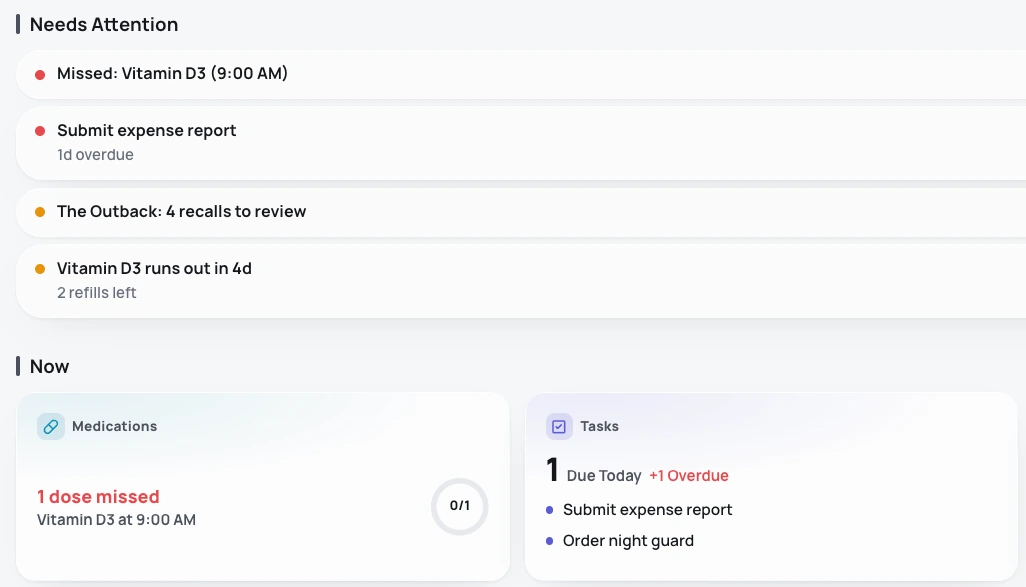
Six tiles is not much room. On a busy day, a dozen parts of your life have something to say. So the real work of the home screen is not showing things. It is choosing the order.
What deserves to come first
Every part of Vritto describes what is going on in plain terms. A dose is due in thirty minutes. A flight leaves this afternoon. A parcel was expected four days ago. Three tasks are due today. A film you have been waiting for comes out on Thursday.
The home screen then weighs all of them with one shared set of rules, so a dose and a film are measured the same way. Those rules come from a few simple ideas.
What is costly to miss, and soon, comes first. A dose that is due, a flight today, a problem with a delivery or an appointment in the next hour leads the board, whatever the time.
The time of day only changes what can wait. In the evening, the next episode of your show can rise and next week's errands can step back. Something that matters right now stays where it is.
A missed dose should look the same at 8 in the morning and at 11 at night.
Fresh comes before stale. Something that went wrong yesterday deserves more of your attention than something that has sat unchanged for months. Older things are still there, but they do not hold the top of the board for ever.
Each thing appears once. If a friend's birthday is in both People and Gifts, it takes one tile, not two.
And quiet is fine. On a calm day, the home screen shows fewer tiles. It does not fill the space with things that do not need you.
An order you can understand
The order of your home screen comes from these rules, not from an AI model. It does not watch what you tap, and it does not quietly learn your habits to keep you scrolling. The web and the phone apps use the same rules, so your day is sorted the same way wherever you open it.
That matters to me. A home screen decides what you notice first, and that is a kind of influence. I would rather it be something I can explain in a few sentences than something that changes for reasons nobody can see.
If you use SahAI, Vritto's assistant, it can add a short brief to your home screen to talk you through the day. That is optional, and it does not decide the order of anything.
A calm place to start the day
I want opening Vritto to feel like talking to someone who has already looked at your day. They tell you about the dose first, then the flight, then the parcel. They mention the new episode later, when the evening comes. And on the days when nothing needs you, they say so.
Your day already has an order. Your home screen should know it.
See the idea in practice
One ordinary day. A more connected picture.
Follow Samira from her morning plans to an evening worth remembering in an illustrative walkthrough of Vritto.
A Day in Vritto